How to plan a group trip without losing your mind.
Seven steps, in order, from "we should do a trip" to everyone paid back. Plus a timeline builder that tells you what to do this week.
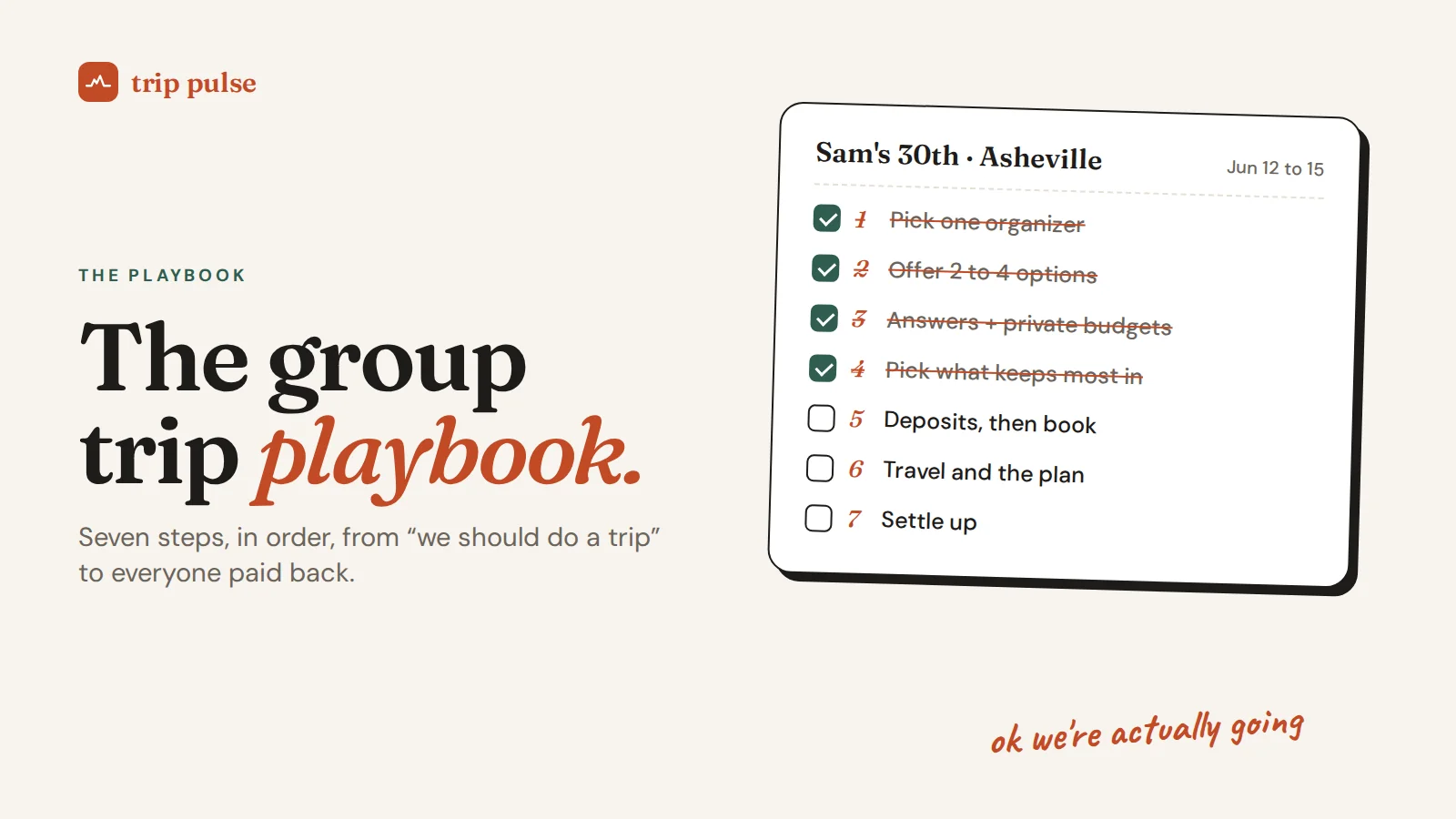
Pick one organizer, offer 2 to 4 specific date and place options, collect everyone's answer and a private budget with a one-week deadline, choose the option that keeps the most people in, then collect deposits and book. For a weekend with flights, start about 12 weeks out. You can do it in 4 if people answer quickly.
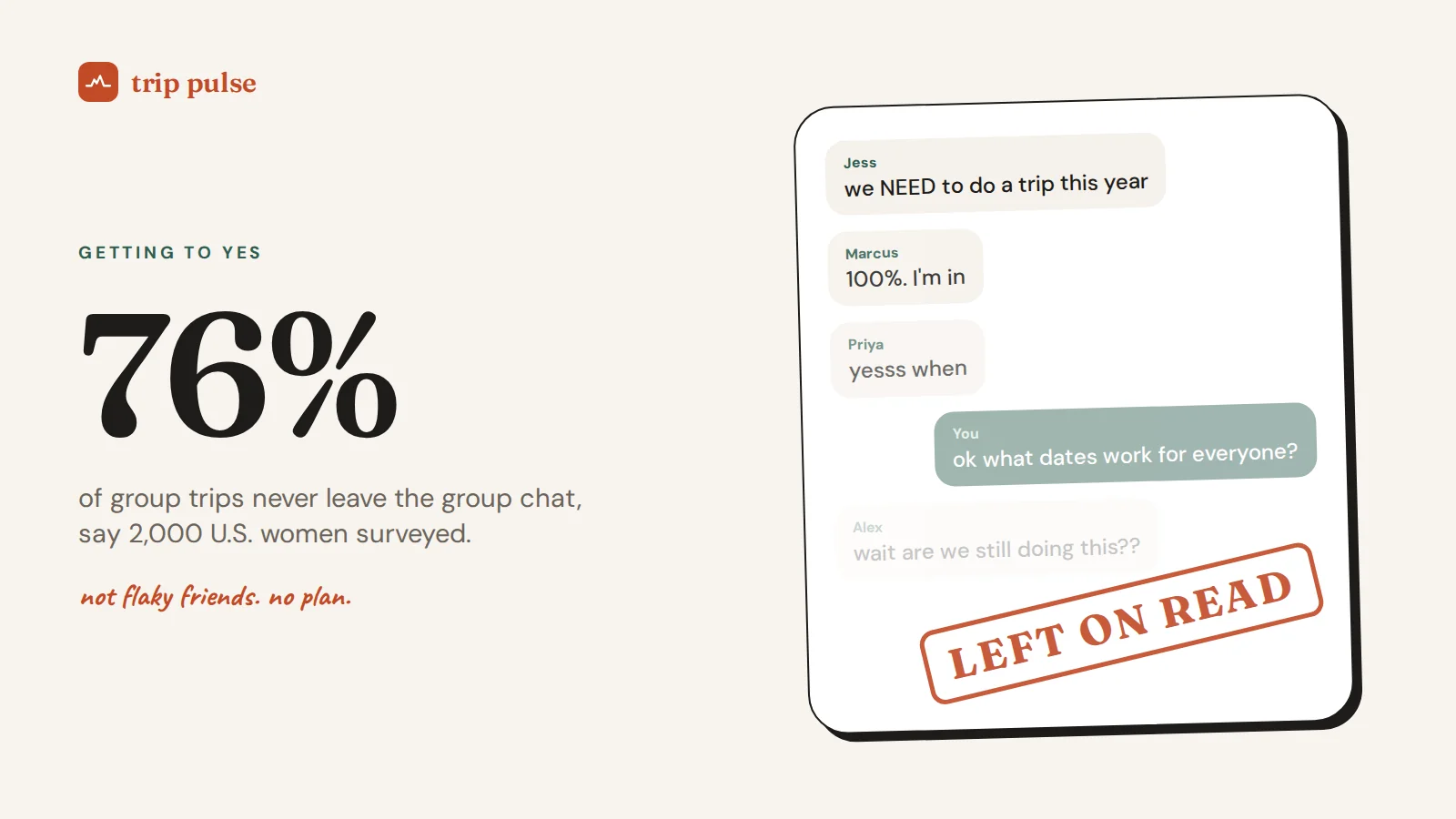
Every group trip starts the same way. Someone sends "we NEED to do a trip this year," nine people heart it, and then nothing happens for five weeks. It isn't that nobody wants to go. It's that nobody knows what the next step is.
This is the next step. All of them, in order. Planning a group trip is mostly a sequencing problem: do things in the wrong order (booking a house before you know who's coming, picking a destination before you know budgets) and you spend the next month renegotiating.
In this guide: the 7 steps · timeline builder · how far ahead to plan · common mistakes
The 7 steps to plan a group trip
- Pick one organizer. One person owns the deadline and makes the call when it's close. Co-planning sounds democratic; in practice five co-planners means zero planners. The organizer doesn't do all the work, they just keep it moving.
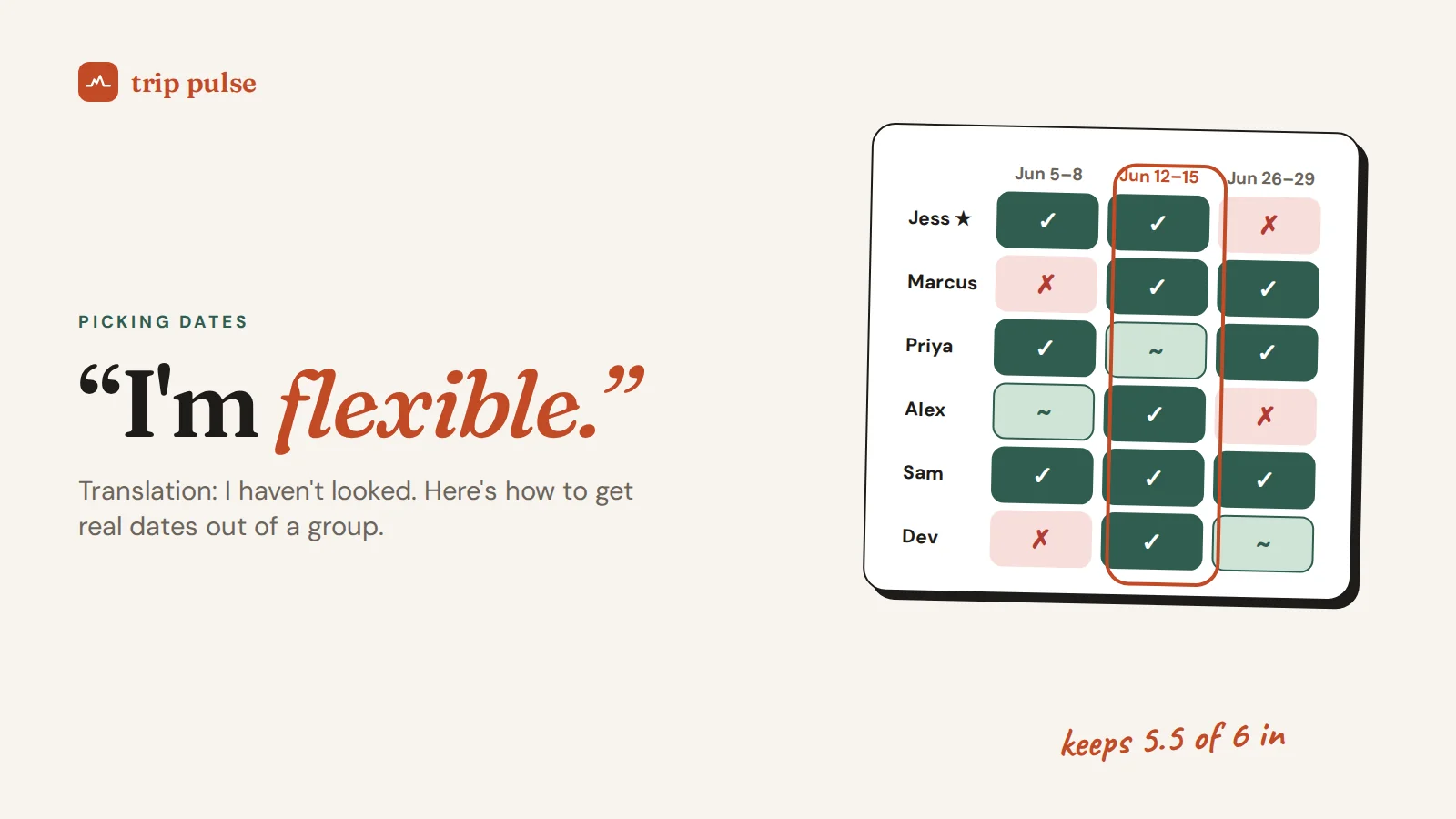
- Offer 2 to 4 specific options. "When is everyone free?" gets you "I'm flexible," which is a lie. "Jun 12 to 15 or Jun 26 to 29?" gets you an answer. Same for places: two or three real contenders with a rough per-person price beats an open brainstorm.
- Collect answers, and budgets, privately and by a deadline. Ask each person three things: are you in, probably, or can't make it; which options work; and what can you realistically spend. Budgets have to be private or people round up to avoid looking cheap. Give a deadline about a week out.
- Pick the option that keeps the most people in. Not the most popular option, and not the organizer's favorite. The one the most people can say yes to without losing anyone the trip can't happen without (the bride, the birthday person). Then announce it clearly: place, dates, rough cost.
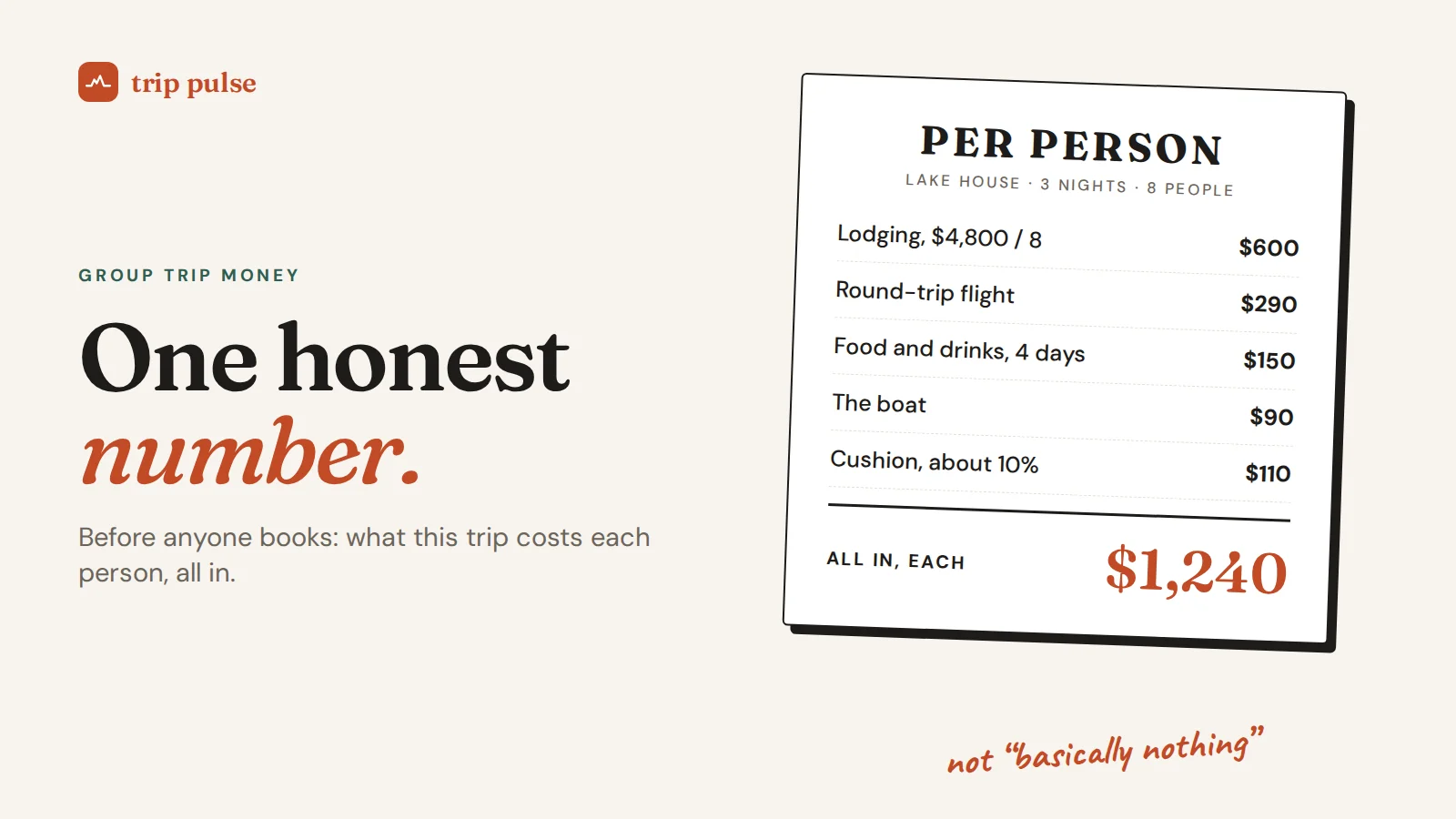
- Collect deposits and book the stay. Money turns "probably" into "I booked my flight." Ask for a deposit before the organizer puts a rental on their card, and book with free cancellation if you can.
- Book travel and plan the days. Everyone books their own travel and shares arrival times so people can share rides. Agree on the one or two things you're actually reserving and leave the rest loose.
- Settle up within a week. Log who paid for what, split it fairly and pay the organizer back first. Do it while everyone still remembers the bottle service.
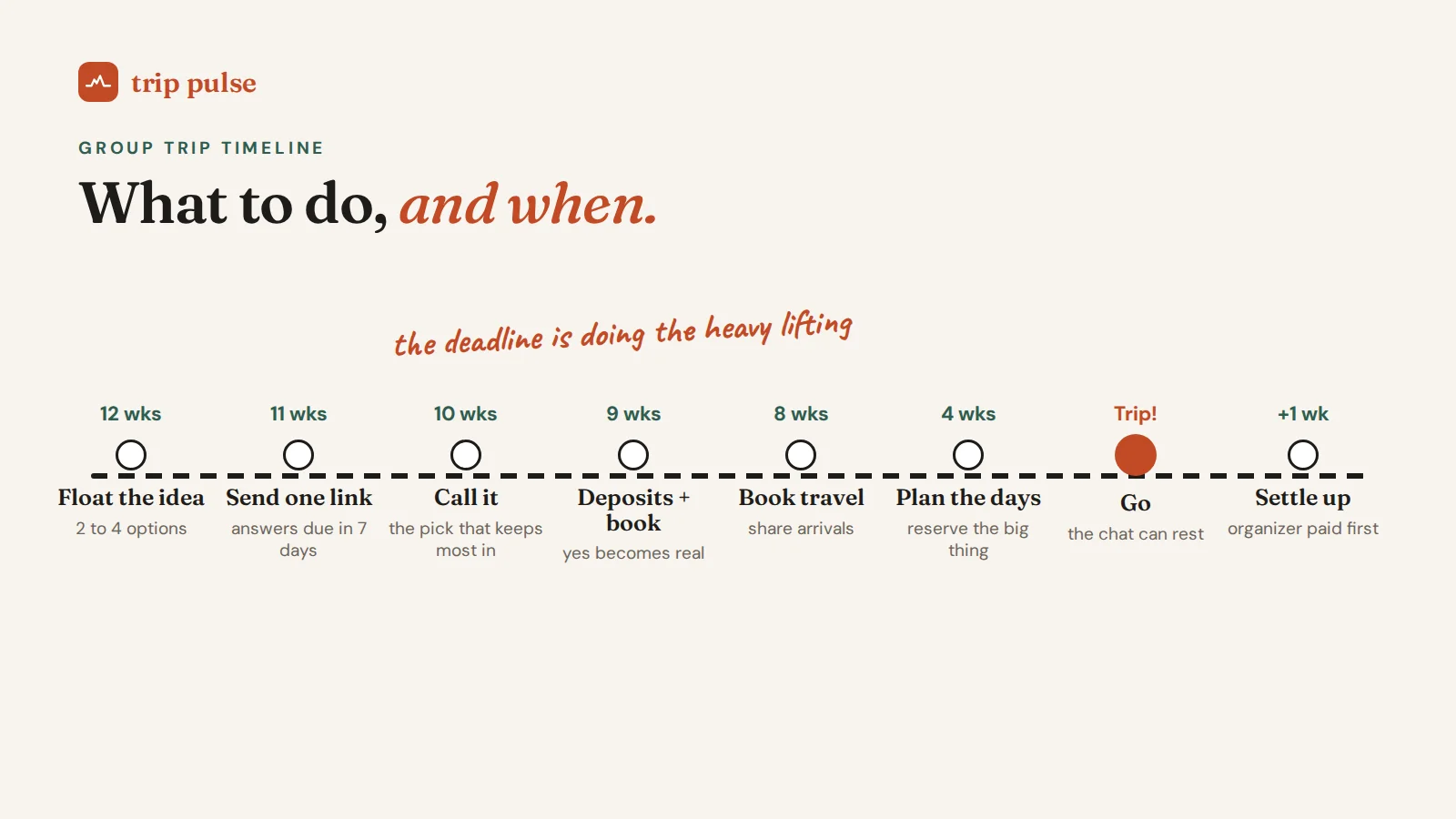
Build your timeline in 10 seconds
Enter the day your trip starts. The timeline works backwards and tells you what to do and when. If you're short on time, it compresses the steps and tells you where to move faster.
The interactive timeline needs JavaScript. The short version: float the idea 12 weeks out, send one link with a 1-week deadline, call it at 10 weeks, book the stay at 9, travel at 8, plan the days at 4, rides at 2, and settle up within a week of getting home.
How far in advance should you plan a group trip?
It depends on how many people, how far they're traveling and how in-demand the dates are. These are the lead times that give most groups room to breathe:
| Trip | Start planning | Why |
|---|---|---|
| Drivable weekend, 4 to 8 people | 6 to 8 weeks out | Enough time for one round of answers and a rental with good options |
| Weekend with flights | 10 to 12 weeks out | Everyone needs time to book flights and time off |
| Bachelor or bachelorette party | 3 to 5 months out | More people, popular weekends, and a guest of honor whose calendar wins |
| International or 10+ people | 5 to 8 months out | Passports, time off and bigger houses all book up early |
| Holiday weekend anywhere | Add a month | Everyone else had the same idea |
The number that matters more than lead time: how long you give people to answer. A week is right for most groups. Longer and people forget; shorter and you get "sorry, just saw this."
The mistakes that sink most group trips
A June 2026 Talker Research survey for Discover Puerto Rico of 2,000 U.S. women found that, by their own estimate, 76% of group trips never happen, and that the ones that do take an average of 83 messages and nearly 19 hours of planning spread over 11 days. Most of that time goes to the same few mistakes:
- Picking the place before the budget. Once someone posts a villa, that's the anchor, and the people who can't afford it go quiet instead of saying so. Collect budgets first. (More on this in the Peace Tax.)
- Open-ended questions. "What does everyone want to do?" is a group project with no due date. Offer choices.
- No deadline. Without one, the slowest person sets the schedule.
- Booking before commitment. The organizer fronts $3,000 for a house, three people drop, and now the organizer has a problem and a grudge.
- Settling up "later." Later means never, and never means the organizer quietly eats $400.
Questions people actually ask
How far in advance should you plan a group trip?
For a weekend with flights, start 10 to 12 weeks out. A drivable weekend can work in 6 to 8 weeks; bachelor and bachelorette parties and international trips need 3 to 8 months. Give people about a week to answer.
How many options should you give the group?
Two to four date options and two or three places. Fewer feels like a done deal; more and nobody can compare them.
What do you do about the friend who never answers?
Set a deadline, send one reminder, then decide without them. You can always add a late yes; you can't get back three weeks of waiting.
Should the organizer pay for everything up front?
No. Collect deposits before booking anything big, and log every expense so the organizer gets paid back first when you settle up.
What's the best way to plan a group trip without a group chat?
Give everyone one link with the same few questions, a private budget and a deadline, then share the decision. The group chat is for memes; decisions go faster somewhere structured.
Or let Trip Pulse run steps 3 through 7.
Send one link. Everyone answers in about a minute with a budget only they can see, reminders go out for you, and you get the pick that keeps the most people in. Then arrivals, the plan and Trip money, all in the same place. Free to plan; $2 per person when you send it, never more than $20.
friends never pay, and never download anythingSurvey data: Talker Research survey for Discover Puerto Rico, June 12 to 18, 2026, 2,000 U.S. women. Lead times are editorial rules of thumb, not booking guarantees.
Keep reading