How to pick dates when everyone is "flexible."
"I'm flexible" means "I haven't looked." Here's how to get real availability and pick the dates that keep the most people in.
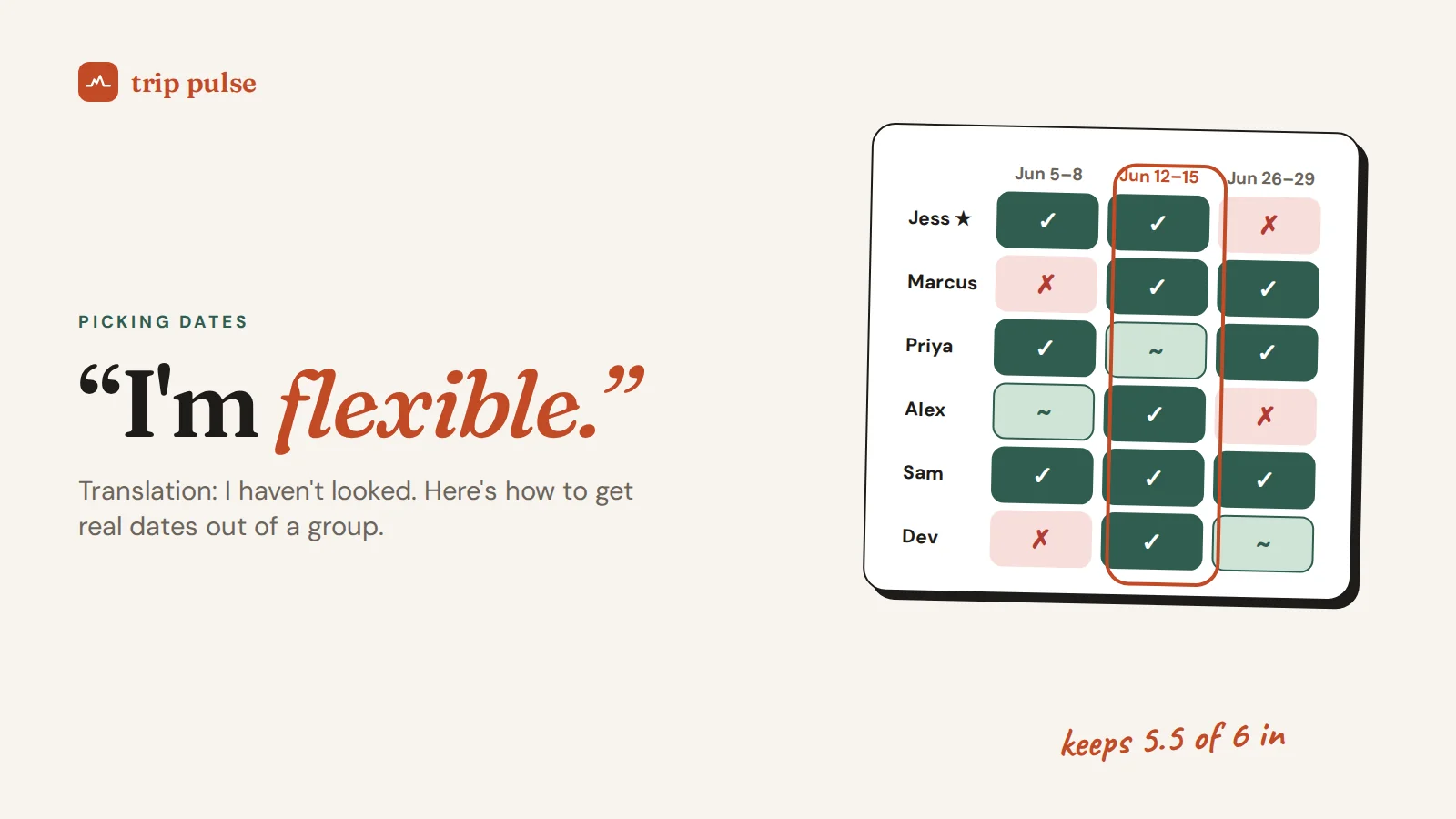
Don't ask when people are free. Offer 2 to 4 specific date ranges, have everyone mark each one works, maybe or can't, star anyone the trip can't happen without, and pick the option that keeps the most people in without losing a starred person. Count a maybe as half a yes, and set a deadline.
Ask a group "when is everyone free?" and you'll get three kinds of answers: "I'm flexible," a list of dates that don't overlap with anyone else's list, and silence. None of those is a date.
Picking dates for a group trip isn't really a scheduling problem. It's a question-design problem. Ask a better question and the dates pick themselves.
Why "when works for everyone?" never works
- It's open-ended. People have to go look at their whole calendar. So they don't, and they say "flexible."
- It hides the trade-off. With eight people there is rarely a date that works for everyone. The real question is which date loses the fewest people, and an open question can't answer that.
- It treats everyone the same. If it's Jess's birthday trip, Jess's calendar isn't one vote out of eight. It's a veto.
The better way to pick dates
- Offer 2 to 4 specific ranges. "Jun 5 to 8, Jun 12 to 15 or Jun 26 to 29." Two feels like a done deal; five and nobody can compare.
- Ask works, maybe or can't for each. A three-way answer is more honest than yes or no, and "maybe" tells you who to nudge.
- Star the people the trip needs. The bride, the birthday person, the one with the lake house. Any option that loses them is out, no matter how many others it keeps.
- Score it: yes is 1, maybe is half. The highest score that doesn't lose a starred person wins.
- Break ties with price, then the guest of honor. Cheaper dates, or the one the starred person prefers.
Try it: find your group's dates
Here's a sample group. Tap any square to change it, rename people and dates, or add your own. The winner updates as you go.
The interactive finder needs JavaScript. To do it by hand: list your date options as columns and people as rows, mark each cell works (1), maybe (0.5) or can't (0), cross out any option a must-attend person can't make, and pick the highest total.
Ask about dates and places separately
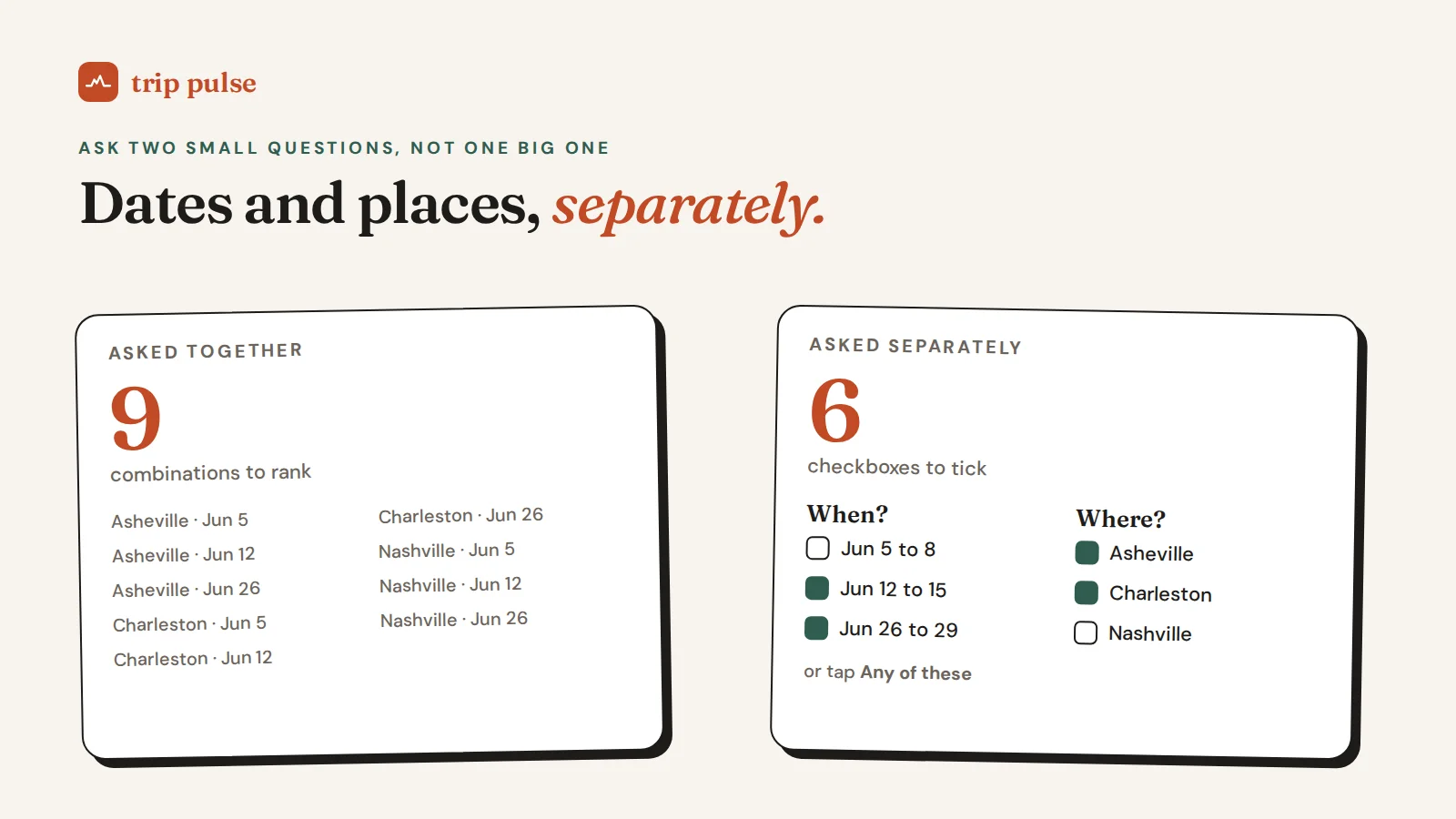
If you're choosing where and when at the same time, don't list every combination. Three places on three weekends is nine options, and nobody wants to rank nine things. Ask two short questions instead: which dates work, and which places would you go to. Six checkboxes instead of nine choices, and you still find the combination that keeps the most people in.
When no date works for everyone
It happens, especially past eight people. You have three honest options:
- Go with the option that keeps the most people in, and say so plainly: "Jun 12 to 15 works for 7 of 9. Sam and Dev, we'll miss you and we'll do dinner when we're back."
- Add one more date option aimed at whoever is missing, then re-ask just that question.
- Shorten the trip. A Friday to Sunday often fits where Thursday to Monday doesn't.
What you shouldn't do: wait for a perfect date. Every week you wait, someone's calendar fills up and flights get pricier.
Questions people actually ask
What's the best way to find dates for a group trip?
Offer 2 to 4 specific date ranges, have everyone mark works, maybe or can't for each, protect anyone the trip can't happen without, and pick the option with the highest score, counting a maybe as half.
How many date options should you give?
Two to four. Enough to find overlap, few enough to compare.
Should you use a scheduling poll like Doodle for a trip?
A poll works for dates alone. For a trip you usually also need who's in, budgets and places, which a date poll doesn't cover.
What if nobody's dates overlap?
Pick the option that keeps the most people in, add one targeted option for the people missing, or shorten the trip to a weekend.
How far ahead should you pick dates?
Lock dates 10 to 12 weeks before a trip with flights, and 3 to 5 months ahead for bachelor and bachelorette parties.
Dates, places and budgets in one link.
Trip Pulse asks dates and places as separate questions, lets people say "any of these," counts probably as half, and never loses a must-attend person. You get the combination that keeps the most people in, with the price per person next to it.
no spreadsheet, no nine-way pollKeep reading